

BACK TO ARTICLES
Data-Driven Principal Investigator Identification: A Smarter Way to Enable Clinical Trial Success

Abstract
The 2025 WCG Clinical Research Site Challenges Report highlights persistent difficulties in clinical trial execution, including limited physician availability, patient recruitment challenges, delays in study start-up, and increasing operational burdens at research sites. These constraints continue to affect enrollment timelines, site performance, and overall trial success.
Principal Investigators (PIs) play a pivotal role in mitigating these challenges; however, traditional PI selection remains manual, relationship-driven, and reliant on self-reported information. This paper outlines the data-driven methodology—powered by ProcDNA’s Principal Investigator Scoring Engine, which integrates multi-source data to objectively assess, score, and rank PIs based on experience, recruitment potential, and operational readiness.
1. Struggles Faced in Conducting Clinical Trials
As per the survey, below are the dominant challenges affecting trial timelines, quality, and overall execution:
- Waning Physician Interest
Reduced availability and declining willingness among physicians to serve as PIs due to administrative burden, increasing protocol complexity, and competing clinical demands.
- Difficulty in Patient Recruitment
Sites struggle to identify, pre-screen, and retain eligible patients, particularly under narrow inclusion/exclusion criteria and rising operational load
- Delays in Trial Initiation
Budget negotiations, contracting, coverage analysis, IRB processes, and technology provisioning routinely extend activation timelines beyond industry expectations.
- Site-Level Operational Challenges
Persistent staffing shortages, turnover, and operational complexity limit the number of studies sites can manage and contribute to variability in performance.
These challenges heighten the importance of selecting strong PIs who bring patient access, operational discipline, and clinical expertise—factors that directly influence feasibility, enrollment reliability, and overall trial execution.
2. Role of Principal Investigators (PI)
The selection of Principal Investigators (PIs) is a critical factor in the success of clinical trials. PIs remain central to trial performance across recruitment, data integrity, and compliance dimensions:
- Boosting Recruitment
A strong patient base enables PIs to achieve enrollment rates
- Enhancing Clinical Data Quality
Experienced investigators enable consistent protocol adherence and reliable data capture.
- Ensuring Compliance
PIs adhere to Good Clinical Practice (GCP) and FDA regulatory guidelines, reducing audit findings and operational risk.
3. Traditional PI Identification Method & its Limitations
Traditional Method
Sponsors have historically relied on a small set of qualitative, relationship-driven steps to identify investigators:
- Experience & Internal Networks
Heavy reliance on known investigators, prior performance, and CRO recommendations.
- Feasibility & Self-Reported Inputs
Site-reported estimates of patient availability, staffing capacity, and anticipated enrollment.
- Basic Site & Compliance Checks
High-level assessments of infrastructure, SOPs, staffing levels, and prior audit outcomes.
Limitations
-These practices form the backbone of traditional PI selection, but they do not fully address modern complexity, rising site burden, or the need for scalable, objective investigator identification. The legacy approach introduces several structural constraints:- Network & Relationship Bias
Favoring familiar investigators restricts access to diverse, emerging, or high-potential PIs.
- Unvalidated Feasibility Inputs
Self-reported metrics lack triangulation with real-world evidence, reducing enrollment predictability.
- Fragmented & Non-Scalable Insight
Manual spreadsheets and disconnected data provide limited visibility into workload, multi-sponsor performance, or phase-level experience.
These limitations heighten the risk of slow enrollment, delayed activation, and inconsistent site performance—issues already magnified by findings in the survey.
4. ProcDNA’s Data-Driven Approach for Effective and Smarter PI Identification
To address these gaps, sponsors need an evidence-driven, multi-source, and scalable method to objectively identify the most suitable investigators—both established and emerging.
ProcDNA’s methodology directly supports this requirement. Our PI identification framework builds a structured, comprehensive, and objective evaluation of investigators that strengthens feasibility, accelerates enrollment, and improves trial outcomes. The methodology involves four key steps:
4.1 Build a Robust PI Database
Create a comprehensive investigator universe by first building the base PI list using claims, prescription, and CMS Open Payments data. Then enrich it with key PI attributes—including patient demographics, prescribing patterns, clinical trial history, geographic footprint, site characteristics, and institutional affiliations—sourced from these datasets and additional inputs such as affiliation databases, Citeline/CRO sources, NIAID trial datasets, social media intelligence, etc.
4.2 Develop a Comprehensive PI Profile using Multi-Source Data
Each PI profile integrates structured attributes from:
- PI demographics gathered from Affiliations data:Include PI specialty, practice location, and years of experience.
- Patient potential derived from Claims data:Evaluate patient demographics, prescribing habits, treatment history
- Clinical value based on Citeline/CRO/NIAID trial data:Utilize PI data from previous and current clinical trials, including phases, enrollment levels, success rates, and current trial load to gauge investigator skill, site effectiveness, and trial experience.
- Academic affinity drawn from Research Publications and CMS Open Payments data:Include affiliations, publication records, and funding history to assess academic contributions.
- Social media influence from web-scraped data: Analyze follower counts, posts, tweets, and social media presence to measure engagement and influence.
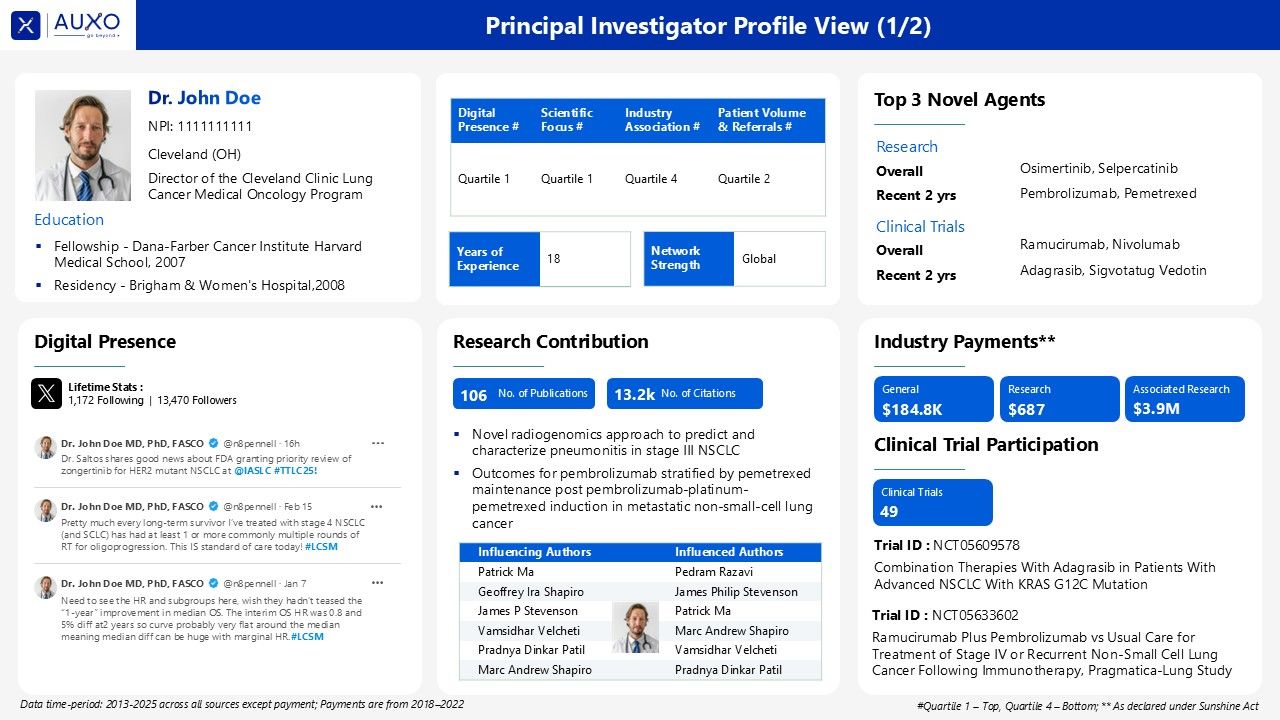
Example of Comprehensive PI Profile View (1/2)
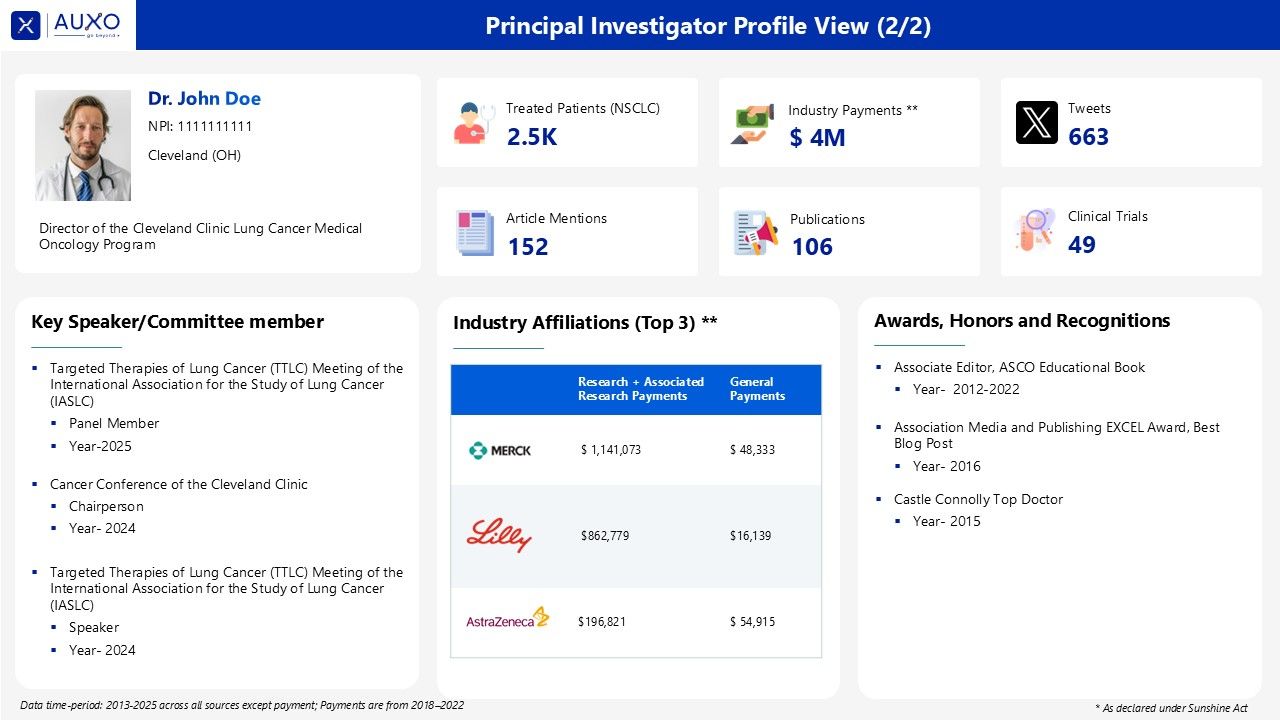
Example of Comprehensive PI Profile View (2/2)
4.3 Run ProcDNA’s Principal Investigator Scoring Engine to algorithmically rank and score PIs
Before running the Scoring Engine, first filter for relevant PIs by reviewing foundational attributes - geography, specialty alignment, and years of clinical experience -to ensure feasibility and therapeutic‑area fit. In parallel, apply demographic filters such as age and gender on patient data to ensure that the PI’s patient population aligns with trial eligibility.
The Scoring Engine generates a composite Principal Investigator Index (PII) by applying weighted metrics across four dimensions: patient potential, clinical value, academic affinity, and social affinity. The weighting hierarchy is patient potential > clinical value > academic affinity > social affinity. By default, industry -standard weights are used: 0.4, 0.3, 0.2, and 0.1, respectively.
Across these four dimensions, the following KPIs are used to evaluate and rank PIs:
- Patient Potential:Evaluate total diagnosed and treated patients, and prescribing patterns that signal treatment preferences and recruitment potential.
- Clinical Value:Evaluates a PI’s trial performance and operational strength based on trial type, patient enrollment volume, phase experience, trial status, success rate, current trial load, and prior relationships with the sponsor.
- Academic Affinity:Measures scientific credibility through publication influence, citation strength, research funding, and academic affiliations that indicate research capability and institutional support.
- Social Affinity:Assesses professional visibility and influence by analyzing follower base, posting activity, audience engagement, and overall digital footprint across medical and scientific platforms.
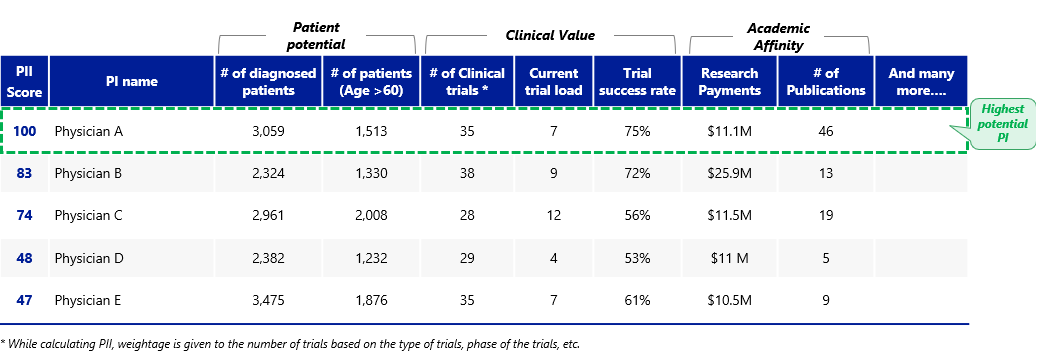
Example of real-world simulation for potential PI, scored using ProcDNA’s PI scoring engine
ProcDNA’s Principal Investigator - Scoring Engine output helps to easily identify the PIs with the highest relevance for our clinical trial
4.4 Generate the Final PI Shortlist
Generate a
ranked shortlist
of top investigators aligned with trial needs. The top-ranked PIs have a proven track record of successful clinical trials, high patient recruitment numbers, and significant research contributions, which will ultimately lead to efficient sponsor and CRO engagements.
5. Conclusion and Future Scope
ProcDNA’s data-driven Principal Investigator (PI) identification methodology offers
a scalable and objective alternative to traditional, relationship-driven selection.
By integrating diverse real-world data sources - claims, Rx, CMS Open Payments, affiliations, and clinical trial intelligence—into a unified profiling and scoring framework, sponsors can reduce network bias, improve feasibility confidence, expand access to high-potential and emerging investigators, and strengthen enrollment predictability. This approach helps trial teams proactively identify investigators with the right combination of patient access, trial execution capability, and scientific credibility, ultimately lowering operational risk and improving the likelihood of on-time, high-quality trial delivery.Building on recent evidence that machine-learning approaches can improve site ranking by predicting site-level patient enrollment using a combination of indication-level historical recruitment and real-world patient data, ProcDNA’s PI Identification framework can evolve from a primarily descriptive scoring model into a more protocol-specific, predictive engine -forecasting expected enrollment volume and enrollment speed for each PI/site under a given set of inclusion/exclusion criteria, and continuously refining rankings as new trial and real-world signals emerge. This would strengthen feasibility confidence upfront, reduce reliance on static assumptions, and enable sponsors/CROs to prioritize investigators who are not only high-scoring in general, but most likely to deliver recruitment targets for the specific study design and indication.
6. Authors

7. References
- https://www.wcgclinical.com/wp-content/uploads/2025/10/siteChallengesReport25__final.pdf
- https://journals.plos.org/plosone/article?id=10.1371/journal.pone.0300109
- https://purplelab.com/wp-content/uploads/2024/12/FINAL-Clinical-Playbook.pdf
- https://milo-healthcare.com/en/site-identification-clinical-trial-experts/
Read more articles
Partner with us
At the heart of our approach is a commitment to your success. We take time to understand your unique challenges and craft tailored solutions that drive meaningful results. Let's build something extraordinary together.
Connect with us


Capabilities
©2026 ProcDNA Inc. | All Rights Reserved