

BACK TO ARTICLES
Synthetic Respondents in Pharma: Opportunity to fill Gaps, within Guardrails

Section (A): What are Synthetic Respondents
While most use cases of Generative AI in Market research have limited themselves to helping speed up an existing process, there is 1 emerging trend that stands out to redefine how MR is conducted, across industries. Generative AI has made it possible to simulate “synthetic respondents” - virtual HCPs, patients, caregivers, or payers that can participate in surveys and interviews on demand. The promise is compelling: faster insights, lower costs, and scale without the traditional constraints of recruitment.
A few months ago, driven by strong client interest in this area, we began exploring the landscape of synthetic respondents. What we found was a spectrum of emerging offerings - ranging from custom-built solutions to ready-made, off-the-shelf panels - often accompanied by bold promises, which looked too good to be true. We took the opportunity to build smaller steps that help solve use cases while maintaining client trust in the development process. As we ran experiments training and testing a variety of different LLMs, the conclusion became clear: while synthetic respondents show real promise, the reality is far more nuanced than what hyped-up marketing suggests.
Synthetic respondents can be powerful, but only when grounded in substantial past research data, applied thoughtfully, and directed at the right types of questions and used to supplement, not replace real respondents.
Why Grounding Matters
Synthetic respondents are not oracles - they are pattern generators. Their value depends on the quality and relevance of the data used to shape them. Without grounding in curated, domain-specific evidence, they risk producing generic, polished but shallow outputs that mislead rather than inform.
Strong synthetic models should:
- Be anchored in a body of historical research- qualitative transcripts, survey microdata, Voice of Customer insights, medical publications, and real-world evidence, often tailored for nuances of a particular therapy area.
- Reflect meaningful variation in opinions of the stakeholders- mirroring the diversity of markets (e.g., high vs. low prescribers, US vs. EU5, safety seekers vs efficacy proponents).
- Undergo validation- benchmarked against hold-out samples or small-scale human reads to ensure they align with reality.
- Be monitored and refreshed- to capture changes in guidelines, emerging therapies, or market sentiment.
Without this foundation, synthetic respondents are little more than general-purpose LLMs “speaking in character.”
ProcDNA’s Point of View
At ProcDNA, we take a disciplined approach. We don’t promote “instant AI panels.” Instead, we help clients build synthetic respondents from their own datawhile integrating our vast understanding of the pharmaceutical market and the research questions that come with it, ensuring:
- Relevance:trained on therapeutic-area-specific evidence, reflecting current realities.
- Rigor:structured validation against past research and hold-out samples.
- Fidelity of variation in opinions:designed to mirror real-world diversity, not just averages.
- Governance:human-in-the-loop processes to decide where synthetic insights suffice and where real respondents are essential.
The outcome is a trusted tool for incremental learning, reducing cycles and costs while safeguarding quality.
Section B: How do they help fill gaps
The Balanced Role in Pharma Insights
Synthetic respondents should be seen as amplifiers, not replacements. They can compress timelines, reduce waste, and sharpen focus when the task is incremental and well-bounded. But they cannot substitute for human depth, emotional nuance, or the ability to anticipate unprecedented change.
The most credible approach is hybrid:
- Synthetic for speed- to prune options, refine instruments, and test hypotheses.
- Human for depth and validation- to capture authenticity, emotion, and confirm decision-critical insights.
This balance ensures that organizations benefit from efficiency without losing the richness of real voices.
In talking to many of our clients in insights and marketing teams, we explored where synthetic respondents can fit in different therapy areas to solve for specific unresolved challenges of today.
Based on these learnings, we are presenting clear pathways for impact that synthetic respondents can create through “Where do I call them” guide.
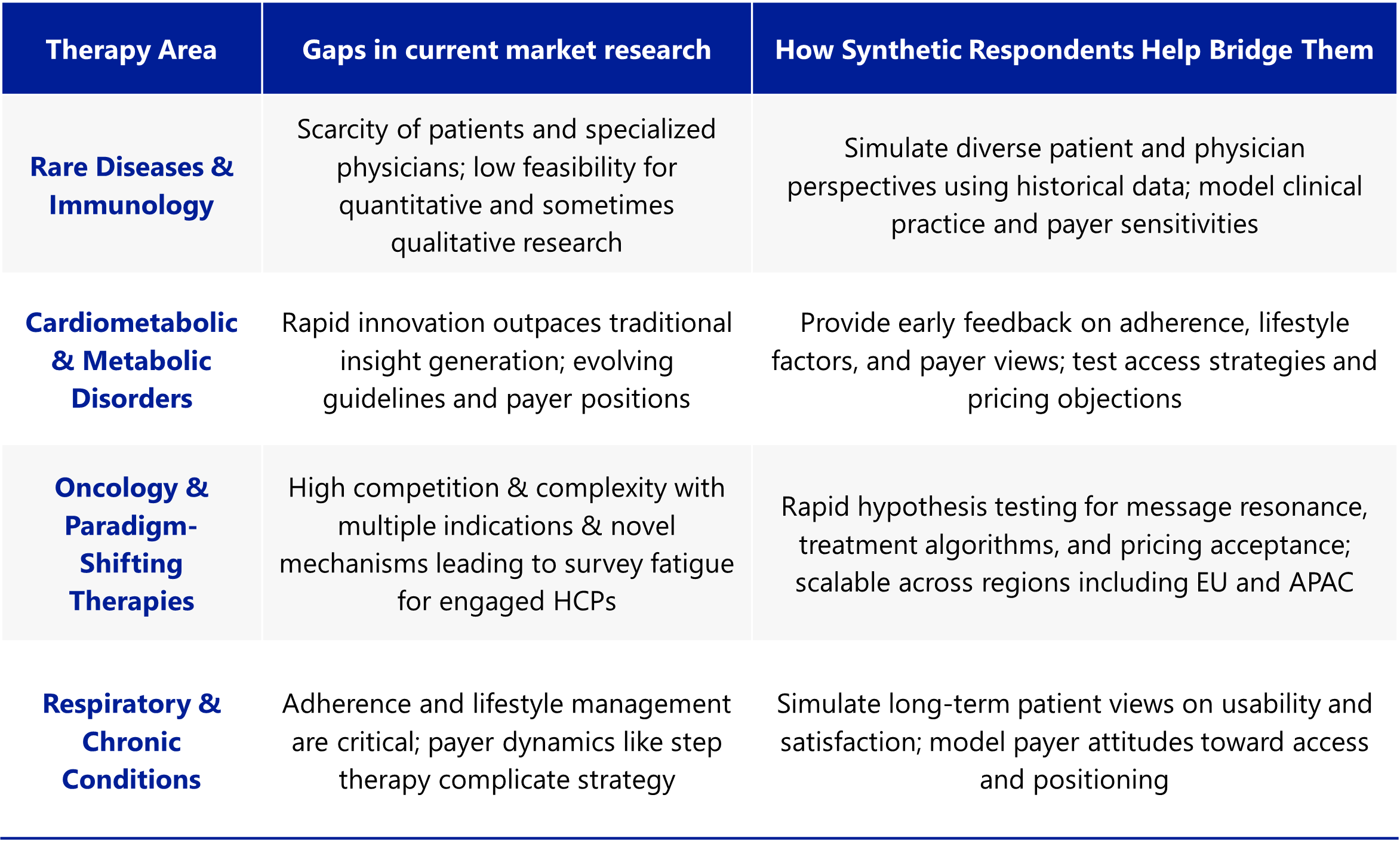
Section C : Concept to Scale : our playbook for leveraging synthetic respondents
It’s critical to take an early pragmatic approach to assess if synthetic respondents can add value to a project or program.
At ProcDNA, we are writing an industry first playbook on how to devise and deploy your strategy on synthetic respondents, anchored on clarity, governance, and measurable outcomes.
Consideration 1: What Synthetic Respondents Can and Can’t Do
Best fit scenarios:
- Piloting and refining discussion guides:highlighting confusing wording, identifying missing probes, and improving flow before expensive fieldwork. Your first draft looks more compelling and fielding ready.
- Testing research operations:running dry-runs of survey instruments or dashboards to identify logic gaps before field deployment.
- Shortlisting concepts or messages:providing quick directional input to narrow options, saving time and cost before validating with real respondents.
- Incremental TPP feedback:stress-testing changes like dosing frequency, administration routes, or packaging - when the broader clinical paradigm is already familiar.
- Hypothesis generation for segmentation:simulating attitudinal clusters to inform more robust real-world segmentation studies.
Avoid using for:
- Radical innovations such as first-in-class therapies, new mechanisms of action, or paradigm-shifting treatment models.
- Emotionally or ethically complex topics where authenticity and lived experience drive insight and potential action for brand or marketing teams.
- High-stakes quantitative decisions (e.g., pricing, forecasting, access strategies) without human corroboration.
Consideration 2: Steps involved in planning and execution
A phased approach ensures credibility and organizational buy-in along with long term success:
- Phase 1: Identify Therapy AreasSelect domains with deep historical data (oncology, cardiometabolic disorders, immunology) and evident gaps which synthetic respondents can help fill
- Phase 2: Pilot ProjectsApply synthetic respondents to small, well-bounded questions (survey flow testing, early message screeners). Refer to our “Where do I call them” guide for initial ideas
- Phase 3: ValidationCompare outputs against small-scale human reads to benchmark accuracy. This may also include training your model on a subset of synthetic respondents, and measuring accuracy of predicted respondents from the remaining of the hold out sample at an aggregate level
- Phase 4: Governance and ScaleFormalize human-in-the-loop processes and expand synthetic respondent use to cross-market research programs. Make sure the global research compliance and reporting requirements are met as we scale these globally. Document results for compliance and audit purposes
Consideration 3: Measuring success
While it may seem tricky to track success of a program which replies on “synthetic replies”, but like any other AI modelling, and MLOps, there are clear ways to measure performance, helping enhance it over time and add more value in subsequent deployments
- Cycle Time Reduction– weeks or months saved in insights generation
- Cost Efficiency– % savings in recruitment and fieldwork spend
- Breadth of Perspectives– ability to simulate under-represented geographies or rare subpopulations
- Validation Accuracy– degree of alignment with human-derived insights
Section D: The road ahead
The future that shall embrace synthetic respondents
While today, the debate goes on for the utility and trust of synthetic respondents, we aren’t very far from the reality where these will become essential to how some market research is conducted. To prepare for this inevitable future, insights team should look to stay ahead of the curve and plan to embrace them as part of their toolkit. The future landscape quickly evolve on several critical parameters:
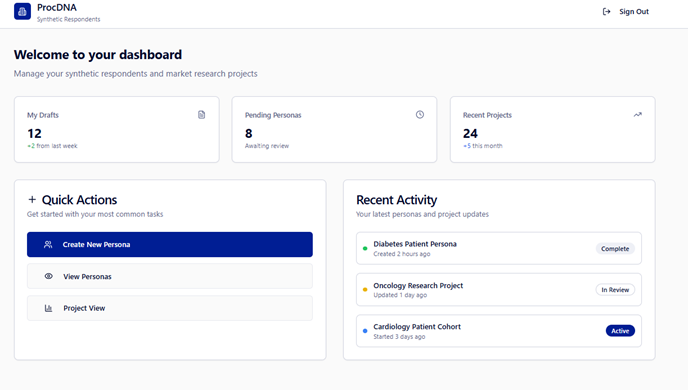
- Updating the Personas:With the ability to have an new claims analytics or market research insights feeding into a calibration engine for synthetic respondents, teams will have a “Persona repository” to select their target respondent population. Teams will be able to field the surveys and discussion guides to a large pool of agent respondents
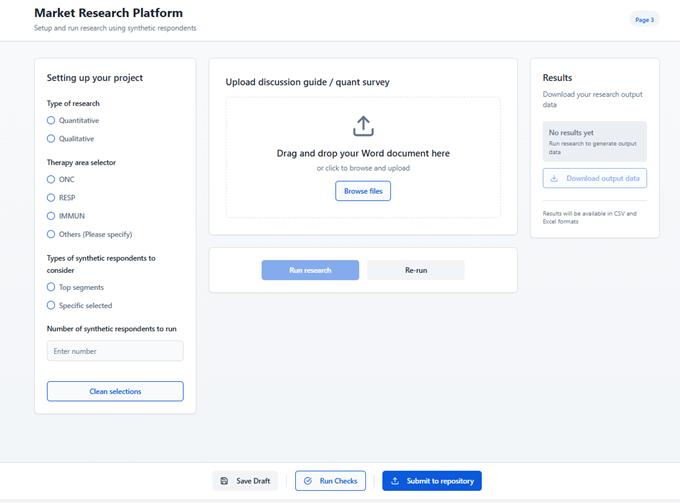
- AI + Human Respondent Pools:Many market research projects may benefit from sequential (for testing and refining) or parallel fielding (for bridging gaps, making sample more representative of the overall population)
- Regulatory Landscape:Strong internal governance of this process would keep us ahead of the curve, while regulation may come in specific areas and applications to make sure the insights generated or applied keep the human empathy and impact in mind
- Broad Adoption:With synthetic respondents bringing time saving in processes, speed to insights, cost efficiency and quality assurance, we will see a broader adoption across processes with quantified positive impact
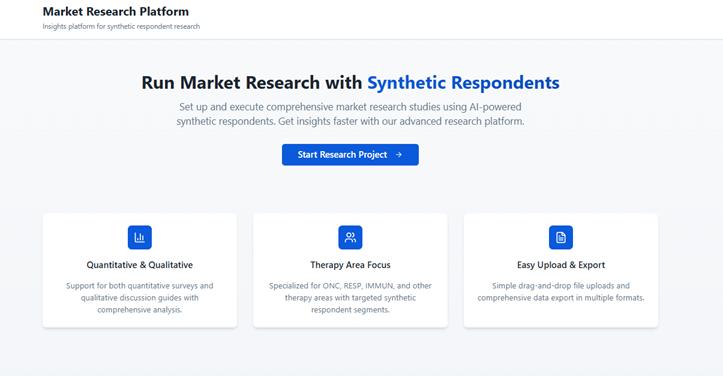
Below is a sneak peak into the future we are building for this incredible evolution to market research:
Closing Thought
Synthetic respondents can accelerate research - but only when used with discipline. The key is not to ask them to do everything, but to point them at the right problems: those that are incremental, evidence-rich, and suited to fast iteration.
At ProcDNA, we believe the future of insights is not AI versus humans, but AI with humans - each applied where they deliver the most value.
Let's connect!
Curious how synthetic respondents can accelerate your pharma insights while maintaining rigor and relevance? Let’s explore how ProcDNA’s disciplined, hybrid approach can help you reduce cycles, sharpen decisions, and scale this exciting new capability responsibly. Our team of leaders - Aritra Das, Nishant Agarwal, and Rajan Dua - are at the forefront of leveraging synthetic respondents to fill data gaps, generate actionable insights, and drive smarter strategies.

Reach out to us to at marketing@procdna.com to discuss a tailored pilot or integration strategy for your organization.
Read more articles
Partner with us
At the heart of our approach is a commitment to your success. We take time to understand your unique challenges and craft tailored solutions that drive meaningful results. Let's build something extraordinary together.

Connect with us


Capabilities
©2026 ProcDNA Inc. | All Rights Reserved